We noted you are experiencing viewing problems
-
Check with your IT department that JWPlatform, JWPlayer and Amazon AWS & CloudFront are not being blocked by your network. The relevant domains are *.jwplatform.com, *.jwpsrv.com, *.jwpcdn.com, jwpltx.com, jwpsrv.a.ssl.fastly.net, *.amazonaws.com and *.cloudfront.net. The relevant ports are 80 and 443.
-
Check the following talk links to see which ones work correctly:
Auto Mode
HTTP Progressive Download Send us your results from the above test links at access@hstalks.com and we will contact you with further advice on troubleshooting your viewing problems. -
No luck yet? More tips for troubleshooting viewing issues
-
Contact HST Support access@hstalks.com
-
Please review our troubleshooting guide for tips and advice on resolving your viewing problems.
-
For additional help, please don't hesitate to contact HST support access@hstalks.com
We hope you have enjoyed this limited-length demo
This is a limited length demo talk; you may
login or
review methods of
obtaining more access.
- Cancer/Oncology
-
2. Cancer vaccines
- Dr. Elias Sayour
-
3. The future of blood tests in cancer treatment
- Dr. Isaac Garcia-Murillas
-
5. Artificial intelligence in precision medicine
- Dr. Michael P. Menden
-
6. How liver X receptor regulates intestinal regeneration and tumor growth
- Dr. Srustidhar Das
- Neurology/Neuroscience
-
7. Integrated multimodal cell atlas of Alzheimer’s disease
- Dr. Michael Hawrylycz
-
8. How and why neurons die in Alzheimer's disease?
- Prof. Bart De Strooper
-
9. Restoring glucose metabolism: a new approach to reversing cognitive decline in AD
- Prof. Katrin Andreasson
-
10. Advancing ALS genetics through accessible testing
- Dr. Teresa Fecteau
-
11. MicroRNA as a biomarker for early detection of amyotrophic lateral sclerosis
- Dr. Sandra Banack
- Dr. Paul Alan Cox
- Dr. Rachael Dunlop
-
12. Translational research in amyotrophic lateral sclerosis (ALS)
- Prof. Aaron D. Gitler
-
13. Muscarinic acetylcholine receptor modulation in neurological diseases- Prof. Andrew B. Tobin
- Immunology & Inflammation
-
14. Role of ETS2 in autoimmune and inflammatory diseases
- Dr. James Lee
-
15. Rheumatic diseases and musculoskeletal pain
- Prof. Anisur Rahman
-
16. Decoy-resistant IL18: how engineered E. coli enhances immune responses against tumors- Dr. Rizwan Romee
-
17. Transmembrane domains and the regulation of trogocytosis in T cells
- Dr. Stefano Barbera
- Infectious Diseases/Microbiology
-
20. Elite controllers of HIV: from discovery to future therapies
- Prof. Bruce Walker
-
22. Towards developing a universal influenza vaccine
- Prof. Peter Palese
- Pharmaceutical Sciences
-
23. The state of the art in secondary pharmacology
- Dr. Jean-Pierre Valentin
-
24. The safety, toxicology, and regulation of antibody-drug conjugates
- Dr. Veysel Kayser
-
26. Management of generic drug development: challenges and opportunities
- Mr. Sandeep Patil
-
27. Translational medicine: the risk of failure in delay and how to reduce it
- Prof. Martin Wehling
-
28. The regulation of cell therapy
- Prof. Moutih Rafei
-
29. Scale-up challenges in the production of nanomedicines from lab to industry
- Prof. Dr. Oya Tagit
-
30. Challenges and solutions of scaling up
- Dr. Shaukat Ali
-
32. Using real-world insights on drug interactions to inform drug development
- Dr. Amita Datta-Mannan
-
33. Role of marketing authorization holder in drug safety
- Dr. Raphael Elmadjian Pareschi
- Methods
-
34. The role of preregistration and registered reports in improving research transparency and reproducibility
- Dr. Peter Bonde Ernst-Rasmussen
-
35. Decoding aging: how a proteomic clock predicts mortality and disease across populations
- Dr. M. Austin Argentieri
-
36. MassBank development and future
- Dr. Emma L. Schymanski
-
37. Synthetic whole embryo models and their applications
- Prof. Jacob (Yaqub) Hanna
-
38. Pioneering proteomics: insights on advancements in the science of proteins
- Prof. Ruedi Aebersold
Topics Covered
- The need for optimizing cell culture processes in biotherapeutic manufacturing
- Key features of a new predictive model to support cell culture processes
- Development and validation of the model
- Key challenges and how they were met
- Wider implications of the model in biopharmaceutical manufacturing
Biography
Shyam Panjwani is currently working as a Principal Data Scientist at Bayer Pharmaceuticals, Berkeley. He holds a PhD degree from University of Houston and a bachelor’s degree from Indian Institute of Technology, Kanpur in chemical engineering. He has 8+ of experience in applying AI/ML/statistics for biologics manufacturing processes, biological assays, and process development. Before joining Bayer, he worked with Halliburton and Air Products
Links
Series:
Categories:
External Links
Talk Citation
Panjwani, S. (2024, December 25). Predictive modelling for cell culture processes in biotherapeutic manufacturing [Audio file]. In The Biomedical & Life Sciences Collection, Henry Stewart Talks. Retrieved February 4, 2026, from https://doi.org/10.69645/OTCC5164.Export Citation (RIS)
Publication History
- Published on December 25, 2024
Financial Disclosures
- Dr. Shyam Panjwani has not informed HSTalks of any commercial/financial relationship that it is appropriate to disclose.
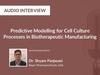
Audio Interview
Predictive modelling for cell culture processes in biotherapeutic manufacturing
Published on December 25, 2024
18 min
A selection of talks on Pharmaceutical Sciences
Transcript
Please wait while the transcript is being prepared...
0:00
Interviewer: Dr.
Shyam Panjwani,
you and your
colleagues published
a paper earlier this
year presenting
a new predictive
model for optimizing
cell culture processes in
biotherapeutic manufacturing and
we would like to discuss
this paper with you in
this short interview.
To kick things off, can you
describe the objective of
the project described
in your paper and
what was the unmet
need behind it?
Dr. Panjwani: Sure!
First of all, thank you
Ail for inviting me and
I'll be happy to share
my research with
your readers and audience.
The objective of
our research was to
enhance the efficiency and
the predictability of the
cell culture process,
specifically in the production
of biotherapeutics.
Our research
specifically aimed at
addressing the unmet need of
a data-driven predictive
model in application
that could predict
bioreactor potency using
at-line process parameters,
days in advance.
There is a reason why we
picked potency because
potency is an attribute which
is not typically measured
on the production floor.
The samples are sent
to a laboratory and so
there is a delay in getting
the potency measurement value.
If we have predictive models
like what we developed,
then we can use those models to
predict potency in the absence
of the measured value.
These kinds of models
actually do not only support
the business objective
but also fulfills
the regulatory requirement that