We noted you are experiencing viewing problems
-
Check with your IT department that JWPlatform, JWPlayer and Amazon AWS & CloudFront are not being blocked by your network. The relevant domains are *.jwplatform.com, *.jwpsrv.com, *.jwpcdn.com, jwpltx.com, jwpsrv.a.ssl.fastly.net, *.amazonaws.com and *.cloudfront.net. The relevant ports are 80 and 443.
-
Check the following talk links to see which ones work correctly:
Auto Mode
HTTP Progressive Download Send us your results from the above test links at access@hstalks.com and we will contact you with further advice on troubleshooting your viewing problems. -
No luck yet? More tips for troubleshooting viewing issues
-
Contact HST Support access@hstalks.com
-
Please review our troubleshooting guide for tips and advice on resolving your viewing problems.
-
For additional help, please don't hesitate to contact HST support access@hstalks.com
We hope you have enjoyed this limited-length demo
This is a limited length demo talk; you may
login or
review methods of
obtaining more access.
- View the Talks
-
1. What is anatomy?
- Prof. Emeritus Bernard Moxham
-
2. The history of anatomy and the practice of anatomy (including imaging)
- Prof. Helen Nicholson
-
3. Introduction to the peripheral nervous system
- Prof. Samuel Asala
- Regional Anatomy of the Trunk
-
4. Thoracic walls, lungs and pleura
- Prof. Jennifer Hayes
-
5. Mediastinum
- Dr. Shiby Stephens
-
6. The heart and pericardium
- Prof. Thomas R. Gest
-
7. An overview of the abdomen
- Prof. Beverley Kramer
-
8. Pancreas, kidneys and ureters
- Prof. Emeritus Kapil S. Satyapal
-
9. Liver and spleen
- Prof. Emeritus Kapil S. Satyapal
-
10. The gastrointestinal (GI) tract
- Dr. Richard L. Drake
- Regional Anatomy of the Musculoskeletal System
-
11. Introductory concepts in limb anatomy
- Dr. Carol Hartmann
-
12. Shoulder, axilla, arm, elbow and cubital fossa
- Dr. Simone Pierre
-
13. Brachial plexus and nerves of upper limb
- Prof. S. P. Banumathy
-
14. Thigh, gluteal region, and knee joint
- Dr. Hannah Shaw
-
15. Anatomy of the leg and ankle: an introduction
- Prof. Nalini Pather
-
16. Anatomy of the back: surface and gross anatomy
- Dr. Joanna Matthan
-
17. Anatomy of the back: muscles and clinical anatomy
- Dr. Joanna Matthan
- Regional Anatomy of the Head and Neck
-
18. Regional anatomy: musculature of the neck
- Prof. Albert van Schoor
-
19. The skull
- Dr. Barry K. B. Berkovitz
-
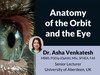
20. Anatomy of the orbit and the eye
- Dr. Asha Venkatesh
-
21. The temporal fossa and temporomandibular joint (TMJ)
- Prof. George Dias
-
22. Infratemporal fossa
- Prof. George Dias
-
23. Essential anatomy of the cranial cavity and brain
- Prof. Iain D. Keenan
-
24. Regional anatomy: nose and pterygopalatine fossa
- Dr. Maria Alessandra Sotgiu
-
25. The oral cavity and pharynx
- Prof. Emeritus Bernard Moxham
Printable Handouts
Navigable Slide Index
- Introduction
- Learning outcomes
- Bones of the orbit
- Foramina of the orbit
- Superior orbital fissure
- The optic canal and inferior orbital fissure
- Structure of the eyeball
- The fibrous coat
- The vascular coat
- The sensory coat
- Contents of the eyeball
- Surface anatomy
- The retina
- The eyelids
- Conjunctiva
- The lacrimal gland
- The lacrimal apparatus
- Arterial supply of the orbit
- Venous drainage of the orbit
- Muscles of the eye: extrinsic muscles
- Oblique and rectus muscles
- Actions of individual EOMs
- Consequences of nerve injury
- Intrinsic muscles of the eye (1)
- Intrinsic muscles of the eye (2)
- Summary
- Financial disclosure
Topics Covered
- Anatomy of the eye
- Orbit of the eye
- The eyelid, conjunctiva, and lacrimal gland
- Intrinsic and extraocular eye muscles
- The lacrimal gland and apparatus
Links
Series:
Categories:
Therapeutic Areas:
Talk Citation
Venkatesh, A. (2025, November 30). Anatomy of the orbit and the eye [Video file]. In The Biomedical & Life Sciences Collection, Henry Stewart Talks. Retrieved December 12, 2025, from https://doi.org/10.69645/IVWN9419.Export Citation (RIS)
Publication History
- Published on November 30, 2025
Financial Disclosures
- There are no commercial/financial matters to disclose.
A selection of talks on Physiology & Anatomy
Transcript
Please wait while the transcript is being prepared...
0:00
Hello. My name is
Asha Venkatesh.
I'm a senior lecturer
in anatomy at
the University of
Aberdeen in the UK.
Today, we are going
to talk about
the anatomy of the
eye and the orbit.
0:17
In this presentation,
we will cover the boundaries
of the bony orbit,
the anatomy of the
globe of the eye,
the anatomy of the eyelid,
conjunctiva, and
lacrimal glands,
and we will describe
the location,
actions, and nerve supply of
the intrinsic and extrinsic
ocular eye muscles.
0:40
The bony orbit is shaped like
a pyramid with a posterior apex,
roof, floor, medial,
and lateral walls.
The frontal bone forms
the roof and superior
margin of the orbit.
The zygomatic bone forms the
lateral margin and wall.
The maxilla forms
much of the inferior
and medial margins of the
orbit, and also its floor.
Posterior to the maxilla,
the medial wall of the orbit
is made up of two bones,
the lacrimal bone and,
posteriorly, the ethmoid bone.
The lacrimal bone is the site of
the lacrimal sac
that collects tears.
The part of the ethmoid
bone that forms
the medial wall of the
orbit is paper-thin
and is called the
lamina papyracea.
Most of the posterior part of
the orbit, including its apex,
is formed by the lesser
and greater wings
of the sphenoid bone.
These two parts are separated
by the superior orbital fissure.
One further bone that makes
up the small posterior part
of the orbital floor
is the palatine bone.
The orbital rim is firm.
You can confirm this by
palpating your own orbital rims.
But the medial wall and
floor of the orbit are weak,
the medial wall because
of the thin ethmoid bone,
and the floor because
of the presence of
the inferior orbital
fissure and groove.
These areas of weakness
are clinically important.
Blunt trauma, such as a blow to
the orbit from a ball
or a punch from a fist,
frequently causes
the medial wall
or the floor of the
orbit to fracture
due to the pressure
transmitted into the orbit
called a blowout fracture.