We noted you are experiencing viewing problems
-
Check with your IT department that JWPlatform, JWPlayer and Amazon AWS & CloudFront are not being blocked by your network. The relevant domains are *.jwplatform.com, *.jwpsrv.com, *.jwpcdn.com, jwpltx.com, jwpsrv.a.ssl.fastly.net, *.amazonaws.com and *.cloudfront.net. The relevant ports are 80 and 443.
-
Check the following talk links to see which ones work correctly:
Auto Mode
HTTP Progressive Download Send us your results from the above test links at access@hstalks.com and we will contact you with further advice on troubleshooting your viewing problems. -
No luck yet? More tips for troubleshooting viewing issues
-
Contact HST Support access@hstalks.com
-
Please review our troubleshooting guide for tips and advice on resolving your viewing problems.
-
For additional help, please don't hesitate to contact HST support access@hstalks.com
We hope you have enjoyed this limited-length demo
This is a limited length demo talk; you may
login or
review methods of
obtaining more access.
- Cancer and Oncology
-
1. Liquid biopsy
- Dr. Fabio Del Ben
-
2. Endometrial cancer: integrating molecular insights into personalized care
- Dr. Gemma Eminowicz
-
5. Latest advances in the development of CAR & TCR T-cell treatments for solid tumours
- Dr. Else Marit Inderberg
-
6. Mode of action of T cells engineered with CAR or TCR for cancer treatment
- Prof. Dr. Sebastian Kobold
-
7. Immunotherapy: insights from advanced disease
- Dr. Sara M. Tolaney
-
8. Recent advances in the field of non-coding RNAs in cancer
- Prof. George Calin
- Dr. Maitri Shah
-
9. How tumor-microenvironment interactions drive or inhibit metastasis
- Prof. Isaac P. Witz
-
10. A novel cancer therapy to stimulate oncogenic ERK signalling
- Prof. Reiko Sugiura
-
11. MRD-driven multiple myeloma treatment: next step forward
- Prof. Ola Landgren
-
12. Germinal centre lymphomas: advances in diagnostic and therapeutic intervention
- Dr. Koorosh Korfi
- Prof. Jude Fitzgibbon
-
13. Immunotherapy in lung cancer
- Dr. Mark M. Awad
-
14. Preservation of fertility in cancer patients: the impact of chemotherapy
- Prof. Kutluk H. Oktay
-
16. Solution proposed to a 2000 year old problem in oncology
- Dr. Michael Retsky
- Clinical Practice
-
18. Comprehensive sickle cell care in the era of gene therapy
- Prof. Sophie Lanzkron
-
19. Stillbirth: diagnosis, investigation and aftercare
- Prof. Alexander E. P. Heazell
-
20. Analyzing the medical relevance of skin care trends
- Prof. Zoe Draelos
-
21. Genetic counseling: preconception, prenatal, perinatal
- Prof. Aubrey Milunsky
-
22. The past, present & future of ANA testing: history and challenges of ANA
- Prof. Marvin J. Fritzler
-
23. The past, present & future of ANA testing: changing bandwidth and future of ANA
- Prof. Marvin J. Fritzler
-
25. Mitochondrial diseases: an update
- Dr. Ayesha Saleem
-
26. Hemophilia A
- Dr. Snejana Krassova
-
29. Recent advances in diagnosis and interventions in ophthalmology
- Dr. Rebecca Kaye
- Prof. Andrew Lotery
- Gastroenterology
-
30. Building implantable human liver tissue from pluripotent stem cells
- Prof. David C. Hay
-
31. Microbiome therapies to treat gastrointestinal diseases
- Dr. Patricia Bloom
-
32. Drug-induced liver injury: importance, epidemiology, and mechanisms of DILI
- Prof. James H. Lewis
-
33. Drug-induced liver injury: risk factors and drug development in DILI
- Prof. James H. Lewis
-
34. Drug-induced liver injury: HDS, diagnosing, treating and preventing DILI
- Prof. James H. Lewis
-
35. An update on the multiple faces of celiac disease
- Prof. Aaron Lerner
- Immunology
-
36. The impact of diet on natural killer cell metabolism and anti-tumor function
- Dr. Rebecca Delconte
-
37. Next-generation RNA vaccines
- Dr. Anna Blakney
-
38. Harnessing the immune system for cancer therapy
- Dr. Raghav Sundar
-
39. Rac-enhanced CAR immunotherapy: RaceCAR
- Prof. Denise Montell
-
40. Enhancing innate anti-tumour immunity: lessons from virotherapy and STING agonism 1
- Prof. Kevin Harrington
-
41. Enhancing innate anti-tumour immunity: lessons from virotherapy and STING agonism 2
- Prof. Kevin Harrington
-
42. Drug allergy: new knowledge
- Prof. Mariana C. Castells
-
43. Biologics as a treatment strategy in food allergy
- Prof. Sayantani B. Sindher
-
44. B cells at the crossroads of autoimmune diseases
- Dr. Xiang Lin
-
45. Studying immune responses “one cell at a time”
- Dr. Mir-Farzin Mashreghi
-
46. Mathematical modeling in immunology
- Prof. Ruy M. Ribeiro
-
47. Therapeutic antibody development
- Prof. Dr. Katja Hanack
-
48. Understanding treatment coverage in mass drug administrations
- Dr. Margaret Baker
-
49. The thymus and T cell development: a primer
- Prof. Georg Holländer
- Infectious Diseases
-
51. HCV resistance
- Prof. John Dillon
-
52. The Global Virus Network: collaboration to address pandemic and regional threats
- Prof. Sten H. Vermund
-
53. New concepts in the management of CAP: a focus on severe illness - treatment and therapies
- Prof. Michael S. Niederman
-
54. New concepts in the management of CAP: a focus on severe illness - MRSA and MDR pathogens
- Prof. Michael S. Niederman
-
55. CRISPR-based suppression drives for vector control
- Prof. Andrea Crisanti
-
56. HIV cure: harnessing innate and adaptive strategies
- Prof. Luis Montaner
- Cardiovascular, Metabolism & Nutrition
-
57. Cow’s milk allergy: the future
- Dr. Carina Venter
-
58. Cow's milk allergy: management
- Dr. Carina Venter
-
59. Moving from GWAS hits to functional variants
- Prof. Steve Humphries
-
60. X-linked hypophosphataemia: genetics, diagnosis and management
- Prof. Thomas O. Carpenter
-
61. What is new in type 1 diabetes?
- Prof. Åke Lernmark
-
62. Current concepts for the management of patients with osteoporosis
- Dr. Michael Lewiecki
-
63. Antibodies to control or prevent type 1 diabetes
- Dr. Robert Hilbrands
-
64. Peptide YY (PYY) in obesity and diabetes
- Dr. Nigel Irwin
- Microbiology
-
65. Vaccines and the fight against antimicrobial resistance 1
- Dr. Annaliesa S. Anderson
-
66. Vaccines and the fight against antimicrobial resistance 2
- Dr. Annaliesa S. Anderson
-
67. Vaccines as a weapon against antibiotic resistance
- Dr. Pumtiwitt McCarthy
-
68. PathoLive: pathogen detection while sequencing
- Dr. Simon Tausch
-
70. Successes and failures with vaccines
- Prof. Stanley Plotkin
-
71. Immunology, the microbiome and future perspectives
- Prof. Sheena Cruickshank
-
72. Impact of the HPV vaccine programme – a changing landscape
- Dr. Kevin Pollock
- Neurology and Neuroscience
-
74. Huxley’s science fiction: ion channels in pain, pain resilience, and beyond
- Prof. Stephen Waxman
-
75. Advances in the diagnosis and treatment of tardive dyskinesia
- Prof. Emeritus Stanley N. Caroff
-
76. Cellular therapies for neurological Injuries: bioreactors, potency, and coagulation
- Prof. Charles S. Cox, Jr.
-
77. Cardiovascular involvement in Parkinson’s disease
- Dr. David S. Goldstein
-
78. Current thinking in pain medicine and some thoughts on back pain
- Dr. Nick Hacking
-
79. Bioelectronic medicine: immunomodulation by vagus nerve stimulation
- Prof. Paul Peter Tak
-
80. Developments & future directions in the management of chronic pain
- Prof. Simon Haroutounian
-
81. Deep Brain Stimulation (DBS) neuromodulation for Schizophrenia
- Prof. Judith Gault
-
82. Parkinson’s at 200 years: an update on Parkinson’s research in 2017
- Prof. Patrick A. Lewis
-
83. Alzheimer's disease: where are we up to?
- Prof. John Hardy
- Pharmaceutical Sciences
-
84. Gene manipulation applications in autoimmune diseases 1
- Dr. Leonardo M. R. Ferreira
-
85. Gene manipulation applications in autoimmune diseases 2
- Dr. Leonardo M. R. Ferreira
-
86. Gene manipulation applications in autoimmune diseases 3
- Dr. Leonardo M. R. Ferreira
-
87. Leveraging healthcare data through artificial intelligence
- Prof. Soma Sengupta
-
88. Integration of multi-omics data
- Prof. Ana Conesa
-
89. Bone marrow mesenchymal cells 1
- Prof. Arnold I. Caplan
-
90. Bone marrow mesenchymal cells 2
- Prof. Arnold I. Caplan
-
91. Peptide-drug conjugates as therapeutic modality in drug development 1
- Dr. Syed Faheem Askari Rizvi
-
92. Peptide-drug conjugates as therapeutic modality in drug development 2
- Dr. Syed Faheem Askari Rizvi
-
93. Pharmacokinetics, -dynamics and dosing considerations in children
- Prof. Dr. Karel Allegaert
-
94. Why in vitro permeation test – and not in vivo?
- Prof. Howard Maibach
-
95. The future of plasma-derived medicinal products (PDMP)
- Dr. Daniele Focosi
-
96. RNA therapeutics: clinical applications and methods of delivery
- Prof. John P. Cooke
-
97. Recent advances in the development of gene delivery technologies
- Dr. Takis Athanasopoulos
-
98. Preclinical translation of mesenchymal stem cell therapies
- Dr. Peter Childs
-
99. Modulating gene expression to treat diseases
- Dr. Navneet Matharu
-
100. Accelerating drug discovery with machine learning and AI
- Dr. Olexandr Isayev
-
101. Emerging big data in medicinal chemistry: promiscuity analysis as an example
- Prof. Dr. Jürgen Bajorath
- Dr. Ye Hu
-
102. Binding kinetics in drug discovery
- Dr. Rumin Zhang
-
103. Modeling of antibody-drug conjugate pharmacokinetics
- Dr. Dhaval K. Shah
-
104. Antibody engineering: beginnings to bispecifics and beyond
- Dr. Ian Wilkinson
-
105. Current challenges in the design of antibody-drug conjugates
- Prof. L. Nathan Tumey
-
106. Inorganic nanostructured interfaces for therapeutic delivery
- Prof. Tejal Desai
-
107. Latest development in therapy-related autophagy research
- Dr. Vignir Helgason
- Respiratory Diseases
-
108. Diagnosis of tuberculosis and drug resistant tuberculosis 1
- Dr. Daniela Cirillo
-
109. Diagnosis of tuberculosis and drug resistant tuberculosis 2
- Dr. Daniela Cirillo
-
110. Respiratory syncytial virus vaccination
- Prof. Peter Openshaw
-
111. Advances in gene therapy for respiratory diseases 1
- Prof. John F. Engelhardt
-
112. Advances in gene therapy for respiratory diseases 2
- Prof. John F. Engelhardt
-
113. Asthma
- Prof. William Busse
- Dr. Amanda McIntyre
-
114. New drugs for asthma
- Prof. Peter Barnes
-
115. CompEx asthma: a novel composite exacerbation endpoint
- Dr. Carla A. Da Silva
-
116. Updates in chronic obstructive pulmonary disease (COPD)
- Dr. Omar S. Usmani
- Archived Lectures *These may not cover the latest advances in the field
-
118. AI and big data in drug discovery
- Mr. Ed Addison
-
119. Molecular brain imaging (PET) in diseases with dementia
- Prof. Emeritus Karl Herholz
Printable Handouts
Navigable Slide Index
- Introduction
- Dietary habits have changed over time
- Dietary modifications as tools to increase health span
- Fasting increases life expectancy across organisms
- Effects of fasting-based diets on tumor burden and metabolism
- Dietary restriction and fasting impact multiple facets of immunity
- Natural killer cells
- Overcoming suppressors of NK cell function
- Can fasting improve NK cell anti-tumor responses and/or NK cell metabolism?
- Cyclic Fasting Diet (CFD)
- CFD reduces solid and metastatic tumor growth
- Reduced tumor growth in CFD mice is dependent on NK cells
- CFD increases NK cell IFN- γ production and degranulation
- Does fasting induce metabolic changes in NK cells?
- NK cells reduce glycolysis in times of nutrient restriction
- NK cells maintain OXPHOS in times of nutrient restriction
- Fasting increases external fatty acid (FA) uptake in splenic NK cells
- Fasting increases external fatty acid uptake in human NK cells
- NK cells in the spleen of CFD mice utilize intracellular sources of lipids
- CFD maintains increased uptake of FAs in splenic NK cells
- CFD NK cells are transcriptionally different & upregulate FAO-associated genes
- Is FAO important for the NK cell anti-tumor response during CFD?
- CPT1A is critical for enhanced NK cell anti-tumor function of CFD
- CFD-induced FAO improves NK cell survival and effector function
- Fasting promotes redistribution of NK cells to the bone marrow
- Acute fasting cycles drive NK cell redistribution to the bone marrow
- Fasting increases the percentage of NK cells in the parenchyma
- NK cells receptors guide their entry and exit from the bone marrow
- Bone marrow entry is required for CFD-mediated tumor activity
- Why is bone marrow entry essential for peripheral NK cell IFN-γ production after CFD?
- Distinct metabolic responses of bone marrow NK cells to fasting
- CFD upregulates IL-12 target genes in bone marrow NK cells
- Elevated BM IL-12 during CFD primes NK cells for peripheral IFN-γ production
- Conclusions
- Acknowledgements
- Financial disclosures
Topics Covered
- Dietary fasting and systemic metabolic changes
- Natural killer cell metabolism under cyclic fasting diet (CFD)
- Role of fatty acid oxidation in NK Cell anti-tumor function
- Fasting promotes NK cell redistribution to and priming within the bone marrow
- CFD-induced metabolic changes in NK cells enhance anti-tumor immunity
Links
Series:
- Natural Killer Cell Biology
- Periodic Reports: Advances in Clinical Interventions and Research Platforms
Categories:
Therapeutic Areas:
Talk Citation
Delconte, R. (2026, May 28). The impact of diet on natural killer cell metabolism and anti-tumor function [Video file]. In The Biomedical & Life Sciences Collection, Henry Stewart Talks. Retrieved May 30, 2026, from https://doi.org/10.69645/AWUN8014.Export Citation (RIS)
Publication History
- Published on May 28, 2026
Financial Disclosures
- There are no commercial/financial matters to disclose.
A selection of talks on Clinical Practice
Transcript
Please wait while the transcript is being prepared...
0:00
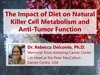
My name is Dr. Rebeca Delconte.
I'm a postdoc at
the Memorial Sloan
Kettering Cancer Center.
Today I'm going to be talking
about the impact of diet
on natural killer
cell metabolism
and anti-tumour function.
0:16
Let's begin by discussing how
dietary habits have
changed over time.
If we compare ancestral or
hunter-gatherer diets
with the present day,
we can observe some
major differences
in diet timing and composition.
For example, in the
past we know that
food sources were variable
as most food was foraged,
which meant that there
were seasonal fluctuations
in availability of food.
Compared to the present
or current western diet,
we are fortunate now to have
a constant supply of calories.
However, this often results in
excess and much of what we
eat is highly processed.
We can see the stark difference
in obesity rates between
ancestral and current diets with
around 40% of the current
population considered obese.
If we look at this
more recent study,
we can see that the increase
in calories is still
occurring with a
higher caloric intake
observed in 2010 compared
with 1970 and an increase in
fats and sugar with
no real increases in
whole foods such as
fruit and vegetables.
1:21
With this in mind, interest in
using dietary
modifications to improve
the health span and longevity of
individuals has increased
over the last ten years.
Many different diets
have been incorporated,
including changes in
dietary composition
such as the Mediterranean
or ketogenic diets.
Restriction of intake
of calories either
through general caloric
restriction or limiting
food intake to specific
windows of time and finally
undergoing periods of fasting or
adhering to fasting
mimicking diets.
Extensive research in this area
has shown that a
reduction in calories and
increased whole foods can have
beneficial effects such as
decreased growth factors,
lower blood glucose and
triglycerides and reduced
oxidative stress.